
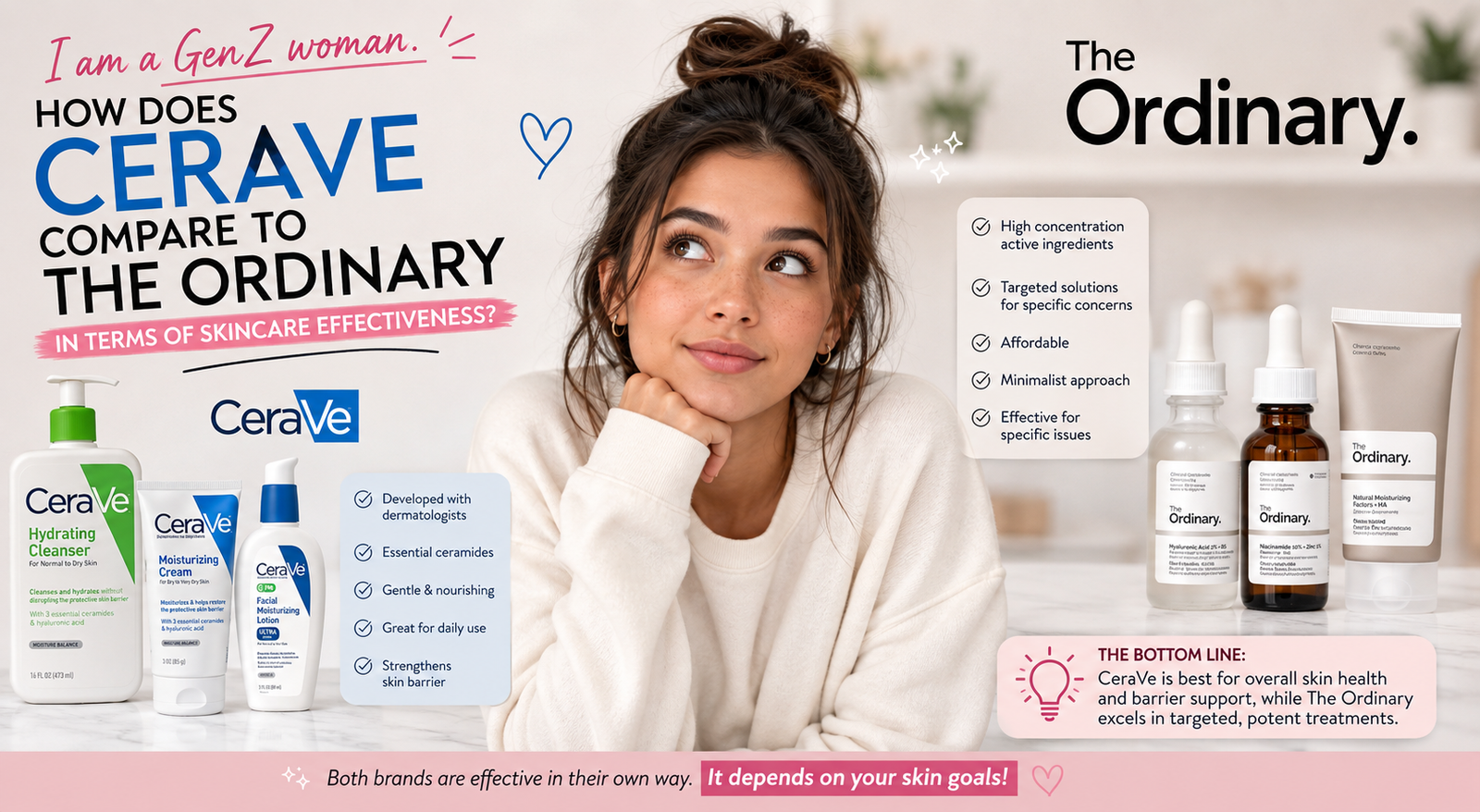
If you’re a Gen Z woman trying to build a skincare routine, you’ve probably seen both CeraVe and The Ordinary everywhere. They’re affordable, widely available, and constantly recommended online—but they take noticeably different approaches to skincare.
So, which one is actually more effective?
The short answer: neither brand wins for every skin concern. CeraVe is generally stronger as a gentle, barrier-supporting foundation, while The Ordinary is particularly useful when you want targeted active ingredients for concerns such as congestion, texture, or uneven tone. The best choice depends on your skin type, concern, tolerance, and how simple you want your routine to be.
That distinction matters because skincare effectiveness isn’t about having the strongest ingredient list. A product needs to address the right concern, suit your skin, and be used consistently. And if social media has convinced you that you need six serums at once, simplifying your routine may actually be the smarter move.
CeraVe vs. The Ordinary at a Glance
| Factor | CeraVe | The Ordinary |
|---|---|---|
| Main approach | Barrier support and everyday skincare | Targeted active ingredients |
| Best known for | Ceramides, cleansers, moisturizers | Serums and concentrated actives |
| Beginner-friendly | Generally yes | Requires more ingredient knowledge |
| Dry or sensitive skin | Strong starting option | Product-dependent |
| Acne and congestion | Selected targeted products | Strong range of targeted actives |
| Routine simplicity | Excellent | Can become complex |
| Customization | Moderate | High |
| Best for | Building a reliable foundation | Targeting specific concerns |
The key point is that CeraVe and The Ordinary aren’t really competing in exactly the same way. CeraVe can provide the foundation of a routine, while The Ordinary can add a targeted treatment when you have a particular problem to address.
What Makes CeraVe Effective?
CeraVe has built much of its identity around supporting the skin barrier. Its current skincare range emphasizes three essential ceramides, while many products also contain ingredients such as hyaluronic acid and niacinamide.
Ceramides and the skin barrier
Ceramides are lipids naturally found in the skin and are important components of the skin barrier. CeraVe says its products contain three essential ceramides designed to help maintain or restore the barrier and reduce moisture loss.
This makes CeraVe particularly appealing if your skin feels:
- Dry or tight
- Rough
- Dehydrated
- Easily irritated
- Stressed from using too many active ingredients
Its Hydrating Facial Cleanser, for example, combines ceramides and hyaluronic acid and is designed to cleanse without stripping the skin’s moisture balance.
Hydration-focused ingredients
Hyaluronic acid is another common CeraVe ingredient. It acts as a humectant, helping attract and retain water in the skin.
Niacinamide also appears in several CeraVe formulas. Depending on the formulation, it can support hydration and help calm the appearance of skin.
The result is a brand that works particularly well for someone who wants a simple skincare routine built around cleansing, moisturizing, barrier support, and daily sun protection.
CeraVe isn’t only for basic hydration
It’s also a mistake to think CeraVe only makes gentle moisturizers.
Its current range includes targeted products containing ingredients such as salicylic acid, retinol, vitamin C, and other treatment-focused ingredients. CeraVe also offers a 2% salicylic-acid acne cleanser.
So the real distinction isn’t “CeraVe doesn’t treat skin concerns.”
It’s more accurate to say that CeraVe puts a strong emphasis on making everyday skincare supportive and tolerable while also offering targeted treatments.
What Makes The Ordinary Effective?
The Ordinary takes a more ingredient-focused approach.
Instead of asking you to buy an entire philosophy of skincare, its range allows you to select products around specific ingredients and concerns.
Targeted active ingredients
For example, The Ordinary currently sells a Niacinamide 10% + Zinc 1% serum aimed at concerns including visible shine, congestion, texture, and dullness.
It also offers a Salicylic Acid 2% Solution specifically formulated for acne-prone skin and congestion.
This can be useful if you know what you’re trying to treat.
Instead of thinking:
“I need a better skincare brand.”
You can think:
“I have clogged pores. Which ingredient is appropriate for that concern?”
That makes The Ordinary attractive to skincare enthusiasts who want customization.
Why The Ordinary appeals to Gen Z
The brand fits naturally into the current ingredient-conscious skincare culture.
You can easily find products marketed around:
- Niacinamide
- Salicylic acid
- Retinoids
- Vitamin C
- Peptides
- Hyaluronic acid
- Exfoliating acids
That ingredient-first approach can make skincare feel more personalized and affordable.
But there’s a catch.
More options can also mean more opportunities to overcomplicate your routine.
CeraVe vs. The Ordinary for Different Skin Concerns
There isn’t one universal winner. Your skin concern should determine which approach makes more sense.
| Skin concern | Better starting approach | Why |
|---|---|---|
| Dry skin | CeraVe | Strong emphasis on hydration and barrier support |
| Sensitive skin | CeraVe-focused | Simpler foundation may be easier to tolerate |
| Acne | Depends | Targeted actives can help, but gentle skincare still matters |
| Oily skin | Either | Choose based on the specific formulation |
| Dark spots | Targeted actives | Ingredients such as vitamin C or retinoids may be useful |
| Texture | The Ordinary or targeted CeraVe | Active ingredients can address specific texture concerns |
| Dehydrated skin | CeraVe | Hydration and barrier support are central |
| Damaged-feeling barrier | CeraVe | Barrier-first routine makes more sense |
| Beginner routine | CeraVe | Easier to keep simple |
| Highly customized routine | The Ordinary | Broad active-ingredient selection |
CeraVe vs. The Ordinary for acne
This one is more complicated than simply declaring The Ordinary the winner.
Salicylic acid is a well-established acne-care ingredient. The American Academy of Dermatology notes that salicylic acid can help open clogged pores and exfoliate the skin.
The Ordinary offers a 2% salicylic acid solution designed for acne-prone skin. Its instructions also warn that combining it with other strong acne treatments can increase the likelihood of irritation and dryness.
CeraVe also offers salicylic-acid products, including its Acne Control Cleanser.
So for acne, the better question is:
Which specific product and routine can address your acne without irritating your skin?
For dark spots and uneven tone
Targeted ingredients can be helpful here, but patience is essential.
A routine might include a suitable brightening or retinoid product alongside moisturizer and sunscreen. Retinoids, for example, can be useful for certain acne, pigmentation, texture, and aging concerns, although they can also irritate some people.
If you’re treating discoloration, don’t overlook sunscreen. Treating dark spots while repeatedly exposing your skin to UV radiation is a poor strategy.
For dry or dehydrated skin
This is where CeraVe has a particularly strong case.
A moisturizer containing ceramides and humectants can provide a useful foundation. CeraVe’s Daily Moisturizing Lotion, for instance, combines three essential ceramides with hyaluronic acid.
The Ordinary also has moisturizing products, so this isn’t an exclusive category. But if your main priority is simple barrier-supporting skincare, CeraVe is an obvious starting point.
Which Is Better for a Gen Z Skincare Beginner?
If you’re completely new to skincare, don’t start by buying every trending serum.
Start with the basics:
- Gentle cleanser
- Moisturizer
- Broad-spectrum sunscreen
Once your basic routine is working, identify one specific concern.
For example, if you’re experiencing clogged pores, you might investigate a suitable salicylic-acid product. If dryness is your main issue, adding another strong active probably isn’t the answer.
Don’t let TikTok build your routine for you
One of the biggest problems with social-media skincare is that someone else’s routine can look convincing without being appropriate for your skin.
You don’t need:
- Three exfoliating acids
- Two retinoids
- Multiple brightening serums
- A dozen-step morning routine
More products don’t automatically equal better results.
If your skin is irritated, simplifying your routine can be more useful than buying another treatment.
Can You Use CeraVe and The Ordinary Together?
Yes, they can complement each other, provided the individual products are compatible with your skin and you’re not overloading your routine with strong actives.
A useful way to think about it is:
CeraVe = foundation
The Ordinary = targeted treatment
For example:
Simple morning routine
Cleanser → moisturizer → sunscreen
Targeted evening routine
Cleanser → one appropriate treatment → moisturizer
The exact treatment depends on your concern.
If you’re using a strong exfoliating acid, for example, don’t automatically add a retinoid and another acid on the same night. The Ordinary itself warns against combining its 2% salicylic acid solution with several other strong active categories because of the potential for irritation and dryness.
If you develop persistent irritation, significant acne, or a skin condition you’re struggling to control, consider getting individualized advice from a dermatologist.
Which Brand Gives Better Value for Money?
Both can offer good value, but don’t judge skincare value only by the price printed on the bottle.
Consider:
- How often you’ll use it
- How much product you need
- How many products your routine requires
- Whether the product addresses your actual concern
- Whether you can use it consistently
- Whether irritation forces you to stop using it
The Ordinary can be attractive for targeted treatments because individual active products can be relatively inexpensive.
CeraVe can provide value when you’re looking for everyday essentials such as cleansers and moisturizers that form the foundation of a routine.
The cheapest product isn’t necessarily the best value if it doesn’t solve your problem.
How Long Does It Take to See Results?
This depends heavily on the product and your skin concern.
Hydration can produce a noticeable difference relatively quickly, while concerns such as acne, pigmentation, and texture generally require consistent use over a longer period.
For example, The Ordinary’s current Niacinamide 10% + Zinc 1% product reports testing showing visible improvements in smoothness and hydration within seven days and changes in pore appearance over four weeks; these are manufacturer-reported results from a specific study and shouldn’t be treated as a guarantee for every user.
Likewise, don’t assume that a product working faster is automatically better.
Consistency, tolerance, and choosing the right treatment matter more than chasing overnight results.
Common Gen Z Skincare Mistakes to Avoid
1. Buying products because they’re viral
Popularity doesn’t mean a product is appropriate for your skin.
2. Using too many actives
Layering acids, retinoids, and other treatments can increase irritation.
3. Skipping moisturizer because your skin is oily
Oily skin still needs appropriate hydration.
4. Forgetting sunscreen
Daily sun protection is especially important when you’re addressing pigmentation and using certain active ingredients.
5. Changing your routine every week
Constantly switching products makes it difficult to know what’s helping or irritating your skin.
6. Assuming tingling means effectiveness
A strong sensation isn’t proof that a skincare product is working.
7. Copying someone else’s routine
Your skin isn’t identical to a creator’s skin, even if you have the same apparent concern.
CeraVe vs. The Ordinary: Pros and Cons
| Brand | Pros | Cons |
|---|---|---|
| CeraVe | Barrier-focused, beginner-friendly, strong cleansers and moisturizers, targeted options available | May feel less customizable for ingredient-focused users |
| The Ordinary | Targeted actives, customizable, ingredient-focused, broad treatment selection | Requires more ingredient knowledge and can encourage complicated routines |
Final Verdict: CeraVe or The Ordinary?
If you’re a Gen Z woman trying to decide between CeraVe and The Ordinary, don’t ask which brand is universally better. Ask what your skin actually needs.
Choose CeraVe if your priority is a simple, dependable foundation focused on cleansing, hydration, and barrier support.
Choose The Ordinary if you have a specific concern and want to explore targeted active ingredients.
And for many people, the smartest answer is both: use a gentle, supportive foundation and add one targeted treatment when you genuinely need it.
The most effective skincare routine isn’t the one with the most products. It’s the one that addresses your concerns, suits your skin, and is simple enough to follow consistently.
FAQs
Is CeraVe better than The Ordinary?
Not universally. CeraVe is particularly useful for barrier support, hydration, and simple routines, while The Ordinary offers a wider ingredient-focused approach for targeted concerns. The better choice depends on your skin type and goals.
Is The Ordinary better for acne than CeraVe?
Not necessarily. Both brands offer acne-related products. The Ordinary has targeted salicylic-acid products, while CeraVe also offers salicylic-acid formulations. Your skin’s tolerance and the rest of your routine matter.
Which is better for sensitive skin, CeraVe or The Ordinary?
CeraVe can be a better starting point if your goal is a simple, barrier-supporting routine. However, sensitivity is individual, so always check the complete ingredient list and introduce new products carefully.
Can I use CeraVe and The Ordinary together?
Yes. A common approach is to use CeraVe for cleansing and moisturizing and add an appropriate The Ordinary treatment for a specific concern. Avoid unnecessarily combining multiple strong actives.
Is The Ordinary good for Gen Z beginners?
It can be, especially if you’re willing to learn about individual ingredients. However, beginners should resist the temptation to build a complicated routine. Start with the basics and add one targeted product at a time.
Which is better for dark spots?
Neither brand is automatically better. Look at the specific active ingredient and formulation instead. Ingredients such as retinoids and vitamin C can play roles in addressing pigmentation concerns, while daily sunscreen is an important part of a routine targeting dark spots.
How often should I change my skincare products?
Don’t change products simply because something new becomes popular. Give a suitable routine enough time to assess how your skin responds, unless you experience significant irritation or another reason to stop. For persistent skin concerns, professional guidance is appropriate.
You May Also Read: Do the Driving Modes in Cadillac LYRIQ Affect Range?