
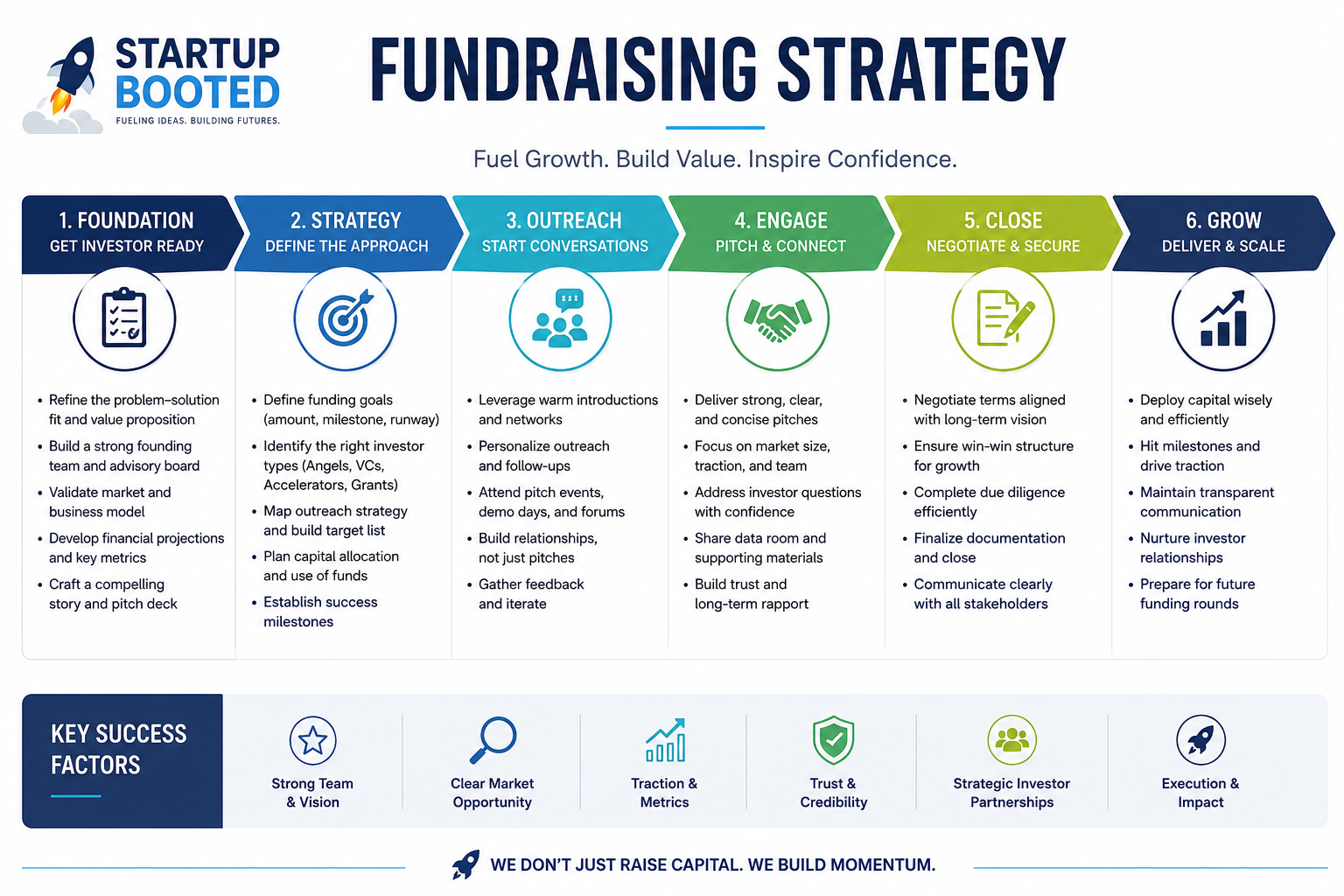
Launching a startup is exciting, but one of the biggest challenges every founder faces is securing enough capital to build, market, and scale the business. While many entrepreneurs immediately think about venture capital or angel investors, another approach has become increasingly popular: the startup booted fundraising strategy.
This strategy combines the discipline of bootstrapping with selective fundraising at the right stage of growth. Instead of raising large amounts of money from the beginning, founders focus on validating their idea, generating revenue, and building a sustainable business before seeking outside investment. The result is often stronger financial health, greater ownership, and improved negotiating power with investors.
Whether you’re building a SaaS platform, an AI startup, an e-commerce business, or a fintech solution, understanding how a startup booted fundraising strategy works can help you make better financial decisions while protecting your long-term vision.
What Is a Startup Booted Fundraising Strategy?
A startup booted fundraising strategy is a growth approach where founders initially finance their business through personal savings, early customer revenue, or small non-dilutive funding sources before raising external investment.
Unlike traditional fundraising, where startups often seek venture capital immediately after launching, this strategy prioritizes building traction first. By proving market demand and creating consistent revenue, founders can negotiate better investment terms when they eventually raise capital.
The goal isn’t to avoid investors forever. Instead, it’s about raising money only when doing so creates significant value for the business.
Why This Strategy Is Becoming More Popular
Today’s investors increasingly favor startups with real customers, recurring revenue, and measurable growth. Businesses that demonstrate financial discipline often receive better valuations because they have already reduced many of the risks associated with early-stage ventures.
For founders, delaying fundraising also means maintaining greater ownership and decision-making authority during the critical early years.
How the Strategy Works
A startup booted fundraising strategy usually follows several logical stages.
Start with Personal Resources
Many founders begin by using personal savings, freelance income, or profits from another business to cover initial expenses.
Keeping early costs low allows entrepreneurs to validate ideas without immediately giving away equity.
Build a Minimum Viable Product
Rather than creating a perfect product, successful startups focus on launching an MVP that solves one clear customer problem.
Early customer feedback becomes more valuable than expensive product development.
Generate Revenue Early
Customer revenue becomes the primary funding source during the bootstrapping stage.
Every sale helps improve the product while reducing dependence on outside investors.
Reinvest Business Profits
Instead of withdrawing profits, founders reinvest earnings into product improvements, hiring, marketing, and customer support.
This creates steady organic growth.
Raise Capital Strategically
Once the company has proven product-market fit, customer traction, and reliable financial metrics, founders can approach investors from a position of strength.
At this point, fundraising becomes a tool for accelerating growth rather than surviving.
Bootstrapping vs Traditional Fundraising
| Feature | Bootstrapping | Traditional Fundraising |
| Ownership | Founder keeps most equity | Equity dilution begins early |
| Decision Making | Founder maintains control | Investors often influence decisions |
| Financial Discipline | High | Moderate |
| Growth Speed | Usually slower | Often faster |
| Business Risk | Lower financial pressure | Higher expectations from investors |
| Best For | Sustainable businesses | High-growth startups |
Neither approach is universally better. The ideal strategy depends on your market, business model, and long-term objectives.
Benefits of a Startup Booted Fundraising Strategy
Greater Ownership
One of the biggest advantages is preserving equity. Every percentage of ownership retained today may become significantly more valuable as the company grows.
Better Financial Management
Limited resources encourage founders to spend carefully, prioritize profitable activities, and avoid unnecessary expenses.
Stronger Investor Negotiation
Investors often prefer startups that have already demonstrated customer demand.
Founders with revenue and traction typically negotiate better valuations than startups with only an idea.
Sustainable Growth
Instead of relying solely on investor money, businesses grow through actual customer demand.
This often creates healthier long-term companies.
Customer-Focused Decision Making
When customers generate revenue, founders naturally focus on delivering real value instead of chasing vanity metrics.
Challenges to Consider
While this strategy offers many benefits, it also presents several challenges.
Slower Expansion
Limited funding may delay hiring, marketing campaigns, or international growth.
Cash Flow Pressure
Unexpected expenses can significantly impact bootstrapped businesses.
Maintaining emergency reserves becomes essential.
Increased Founder Responsibility
Without outside funding, founders often handle multiple roles including marketing, sales, operations, customer support, and finance.
Competitive Markets
In industries where competitors receive millions in venture funding, bootstrapped startups must rely on efficiency and innovation rather than spending power.
When Should You Raise Outside Capital?
External funding becomes appropriate when it clearly accelerates an already successful business.
Common indicators include:
- Strong recurring revenue
- Proven product-market fit
- High customer retention
- Growing sales pipeline
- Demand exceeding operational capacity
- Expansion opportunities requiring additional capital
Raising money before achieving these milestones often results in unnecessary equity dilution.
Funding Options Beyond Traditional Venture Capital
Modern founders have more financing choices than ever before.
| Funding Option | Best For | Equity Required |
| Bootstrapping | Early validation | No |
| Angel Investors | Early growth | Yes |
| Venture Capital | Rapid scaling | Yes |
| Revenue-Based Financing | Growing SaaS companies | No |
| Government Grants | Innovation projects | No |
| Startup Accelerators | Mentorship and networking | Usually |
| Crowdfunding | Consumer products | Sometimes |
| Strategic Partnerships | Industry expansion | Usually No |
Choosing the right funding source depends on your growth stage and business goals.
A Practical Roadmap for Startup Success
Following a structured roadmap increases the likelihood of sustainable growth.
Step 1: Validate Your Idea
Speak with potential customers before building anything.
Understand their biggest problems.
Step 2: Launch an MVP
Focus on solving one core problem exceptionally well.
Avoid unnecessary features.
Step 3: Acquire Paying Customers
Revenue provides both funding and market validation.
Even a small group of loyal customers can prove demand.
Step 4: Improve Unit Economics
Optimize acquisition costs while increasing customer lifetime value.
Healthy unit economics attract investors.
Step 5: Build Predictable Revenue
Recurring revenue models such as subscriptions create financial stability.
Step 6: Document Growth
Track revenue, customer acquisition, churn, and profitability.
Reliable data strengthens investor confidence.
Step 7: Prepare Investment Materials
Develop a professional pitch deck, financial model, executive summary, and growth strategy before approaching investors.
Essential Startup Metrics
Every founder should monitor key financial indicators.
Monthly Recurring Revenue (MRR)
Measures predictable monthly income.
Annual Recurring Revenue (ARR)
Projects yearly recurring revenue.
Customer Acquisition Cost (CAC)
Shows how much it costs to acquire a new customer.
Customer Lifetime Value (LTV)
Measures the long-term value generated by each customer.
Burn Rate
Tracks monthly business expenses.
Runway
Calculates how many months the company can operate before requiring additional funding.
Churn Rate
Indicates the percentage of customers leaving over time.
Investors frequently evaluate these metrics when assessing startup performance.
Real Startup Examples
Many successful companies initially relied on bootstrapping before pursuing larger growth opportunities.
Mailchimp
Mailchimp operated profitably for years without venture capital, focusing on customer revenue before eventually becoming one of the world’s leading email marketing platforms.
Atlassian
Atlassian built a highly profitable software company while minimizing outside investment during its early years.
Basecamp
Basecamp emphasized profitability and customer satisfaction over aggressive fundraising, proving sustainable growth can outperform rapid expansion.
These examples demonstrate that disciplined financial management often creates stronger businesses.
Common Founder Mistakes
Many startups struggle because of avoidable mistakes.
- Raising capital before validating demand
- Spending aggressively after receiving investment
- Hiring too quickly
- Ignoring customer feedback
- Focusing on vanity metrics instead of revenue
- Giving away excessive equity during early funding rounds
- Failing to monitor cash flow regularly
Avoiding these mistakes significantly improves long-term success.
Startup Funding Trends
Startup financing continues evolving as investors prioritize sustainable business models.
Recent trends include:
- Increased focus on profitability over rapid expansion
- Greater interest in AI-powered startups with recurring revenue
- Growing popularity of revenue-based financing
- More government innovation grants
- Stronger investor preference for startups demonstrating capital efficiency
Founders who combine disciplined bootstrapping with strategic fundraising are increasingly viewed as lower-risk investment opportunities.
Businesses featured on respected entrepreneurial platforms such as Ceotoday, Tweakyourbiz, and Fintechasia frequently highlight sustainable growth, operational efficiency, and long-term value creation as characteristics of resilient startups. Reviewing Startup booted reviews from founders and business communities also shows that many entrepreneurs appreciate maintaining ownership while raising capital only when it supports meaningful expansion.
Practical Tips for First-Time Founders
- Focus on solving real customer problems.
- Build revenue before chasing investment.
- Keep operating expenses lean.
- Track financial metrics every month.
- Create a detailed financial forecast.
- Develop investor relationships before you need funding.
- Continue learning from successful founders and industry publications.
- Raise money to accelerate proven growth, not to validate an untested idea.
Conclusion
A startup booted fundraising strategy offers founders a balanced approach to building a successful business. By combining disciplined bootstrapping with carefully timed fundraising, entrepreneurs can retain more ownership, strengthen financial fundamentals, and negotiate better investment terms.
While external funding remains valuable for scaling the right business, the strongest startups often prove their value through customers before approaching investors. This approach reduces risk, builds credibility, and creates a healthier foundation for sustainable long-term growth.
Whether you’re launching your first startup or preparing for your next funding round, focusing on customer value, financial discipline, and strategic capital decisions will position your business for lasting success.
Frequently Asked Questions
What is a startup booted fundraising strategy?
It is a business growth approach where founders initially rely on personal funds, customer revenue, or non-dilutive financing before raising outside investment to accelerate growth.
Is bootstrapping better than venture capital?
Neither option is universally better. Bootstrapping offers greater ownership and financial discipline, while venture capital can help businesses scale more rapidly.
When should a startup seek external funding?
The ideal time is after achieving product-market fit, generating consistent revenue, and demonstrating measurable customer traction.
Can a startup succeed without investors?
Yes. Many successful companies have grown primarily through customer revenue before choosing to raise little or no external capital.
What metrics do investors care about most?
Common metrics include Monthly Recurring Revenue (MRR), Annual Recurring Revenue (ARR), Customer Acquisition Cost (CAC), Customer Lifetime Value (LTV), burn rate, runway, and churn rate.
What are non-dilutive funding options?
Government grants, revenue-based financing, business competitions, customer pre-sales, and certain startup accelerator programs can provide funding without requiring founders to give up ownership.
You May Also Read: Joaquin Duato and Margot Robbie