
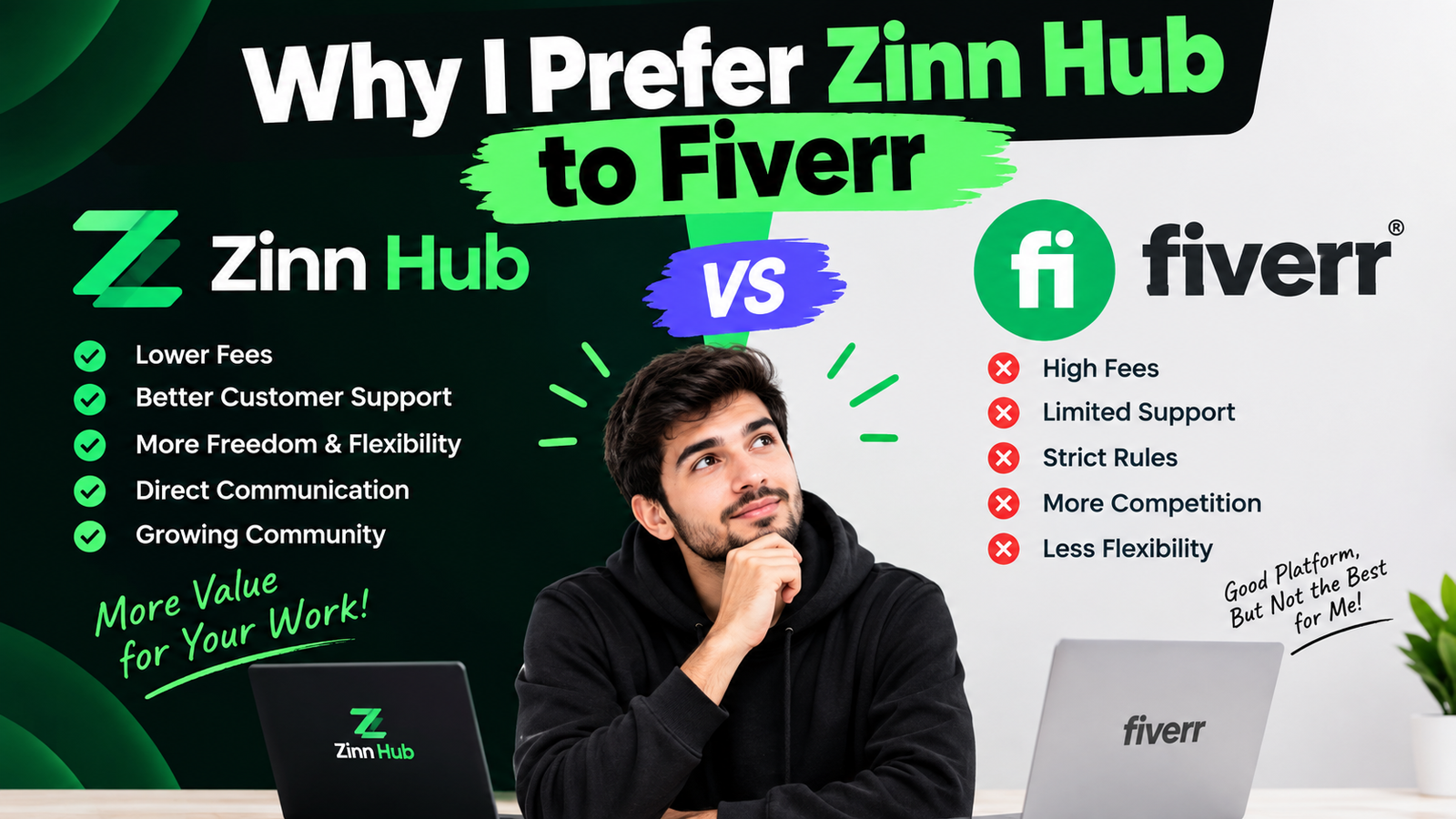
I prefer Zinn Hub to Fiverr as a freelancer because the money that hits my account, the price
the buyer actually sees, and the fact that I can still reach a person all work in my favour.
Fiverr still has more traffic. That traffic is also the problem.
Fiverr is saturated
I am not trying to win a crowd of ten thousand identical gigs.
Open a Fiverr category I actually sell in — logos, web copy, SEO, video editing, WordPress
— and it is the same wall. Thousands of listings, similar thumbnails, “I will do it in 24 hours”,
and a constant race to the bottom to get noticed.
New sellers wait in that pile with no reviews. Established sellers defend their ranking by
responding quickly and competing hard on price.
The marketplace is not short of freelancers.
It is short of oxygen.
Zinn Hub is smaller. That is the point.
I am not invisible the week I publish. Zinners are verified with government-issued photo ID
and evidence of their skills and past work before they can list services or respond to
Projects.
Fewer neighbours means my package can be priced like work, not like a clearance bin.
I would rather be early in a shop that still has shelf space than page 14 of a category that
has been crowded for years.
The buyer fee is my problem too
On Fiverr, I do not only lose 20%.
The buyer also pays a 5.5% service fee at checkout, with an additional $3.50 on orders
under $200 under Fiverr’s current payment terms. The fee also applies to additional
payments such as extras and tips.
So my $50 package is not simply $50 at checkout. Under the current standard fee, the buyer
pays $56.25 before any other applicable costs.That extra sits on their card, but it can still become my conversion problem.
On Zinn Hub, there is no Zinn Hub platform fee added to the buyer’s price. The price I
publish is the price the buyer sees from the platform, before their chosen payment provider’s
normal processing arrangements.
That changes how I think about pricing:
● I can price the work, not the platform.
● I do not have to undercut myself to compensate for a marketplace fee at checkout.
● Smaller first orders have a lower platform-cost barrier for the buyer.
● A repeat buyer does not get a separate Zinn Hub platform fee added simply for
choosing me again.
Fiverr’s seller fee affects my side of the transaction. Its buyer fee affects the other side.
I feel both.
I keep the first $500
Fiverr’s standard freelancer earnings are 80% of the client’s cleared payment.
On Zinn Hub, the first $500 I earn is commission-free. After that, the free plan moves
through published lifetime-sales tiers, eventually reaching 8%. Pro is a flat 8% and Agency is
7%.
That first $500 matters.
The first clients are often the hardest to win. You have no established marketplace history,
fewer reviews and no proven track record on that particular platform.
Keeping that first $500 gives a new freelancer more room to establish themselves.
It is a very different proposition from losing 20% from the first order onwards.
I get paid differently
Fiverr’s standard clearance period is 14 days after an order is completed. Eligible
programmes, including Top Rated, Seller Plus and Pro Talent, can have a seven-day
clearance period.
Zinn Hub gives me a different option.
I can connect my own Stripe or PayPal account so buyers pay me directly at checkout.
Alternatively, I can use Zinn Hub’s platform-protected payment system, where the platform
holds the payment until the order is completed and then pays from its payout process.
That choice matters to me.I can decide whether I want direct payment through my own payment account or the
protection of a platform-held transaction.
I do not pay for the right to ask for work
Fiverr is largely a shop window. My Gig has to compete for attention in a very crowded
marketplace.
Zinn Hub gives me three ways to sell from one profile:
● packaged Zinns
● Projects with free proposals
● a public Freelancer Directory
There are also Micro Zinns at fixed $5, $10, $15 and $20 price points.
That means I can sell a ready-made service, respond to a project brief without buying
bidding credits, and still be discoverable through the directory.
In a crowded market, being able to go and get the work matters as much as having a listing.
I want to be able to reach a person
This is the part that matters to me more than it might sound.
When something goes wrong with an order, payment or account, I want a route to actual
support. Fiverr does provide support and its Resolution Centre, and higher-level
programmes such as Fiverr Pro include priority support.
But my preference is still for a marketplace where the support relationship feels more
accessible.
Zinn Hub is a smaller platform, and that makes a difference to how I experience support.
There is also Zinn Concierge for buyers, while Zinn Hub’s own team supports the
marketplace.
I am not romantic about chat widgets. I have lost days trying to resolve marketplace
problems before.
That is billable time I cannot invoice anyone for.
Honest pricing is easier when the catalogue is gated
Fiverr’s enormous catalogue is one of its biggest strengths — and one of its biggest
challenges for an individual freelancer.When thousands of people offer broadly similar services, price, reviews, response times and
search visibility become increasingly important.
Zinn Hub takes a different approach.
Freelancers are checked with government-issued photo ID and evidence of skills and
previous work before they can sell.
That does not magically remove competition.
It does mean I am not competing purely against an endless wall of unverified profiles.
For me, that makes it easier to present a professional package at a professional price.
Language creates another market
This is one of the biggest differences for me.
Zinn Hub operates across 45 site languages, with messaging available in 57 languages.
Listings, messages and other marketplace content can be translated, and live language
translation is available during calls.
I can write my listing in the language I am comfortable with.
The buyer can read it in theirs.
That is more than a translation button.
It potentially puts my services in front of buyers I might never have reached through an
English-first marketplace.
What I am not pretending
Fiverr still sends more people through the door.
That is real.
Its enormous audience is an advantage, and freelancers who have spent years building
reviews and ranking on Fiverr have something valuable there.
But more traffic does not automatically mean an easier marketplace for an individual
freelancer.
Sometimes more traffic means more competition.
More listings.
More price pressure.More sellers fighting for the same buyer.
And more effort required to stand out.
I prefer the platform where:
● I am not buried in an enormous category.
● The buyer does not pay a separate Zinn Hub platform fee.
● I keep the first $500 commission-free.
● My commission can fall as my lifetime sales grow.
● I can connect my own Stripe or PayPal account.
● I can sell packages, respond to Projects for free and use a public directory.
● My profile is backed by ID and skills verification.
● I can sell across language barriers rather than relying entirely on shared English.
● There is a smaller marketplace where human support feels more accessible.
Fiverr has the traffic.
Zinn Hub has the room.
As a freelancer, I would rather build somewhere I still have room on the shelf — and where
the economics of the sale work for both me and the buyer.
Written By Anonymous Zinner