
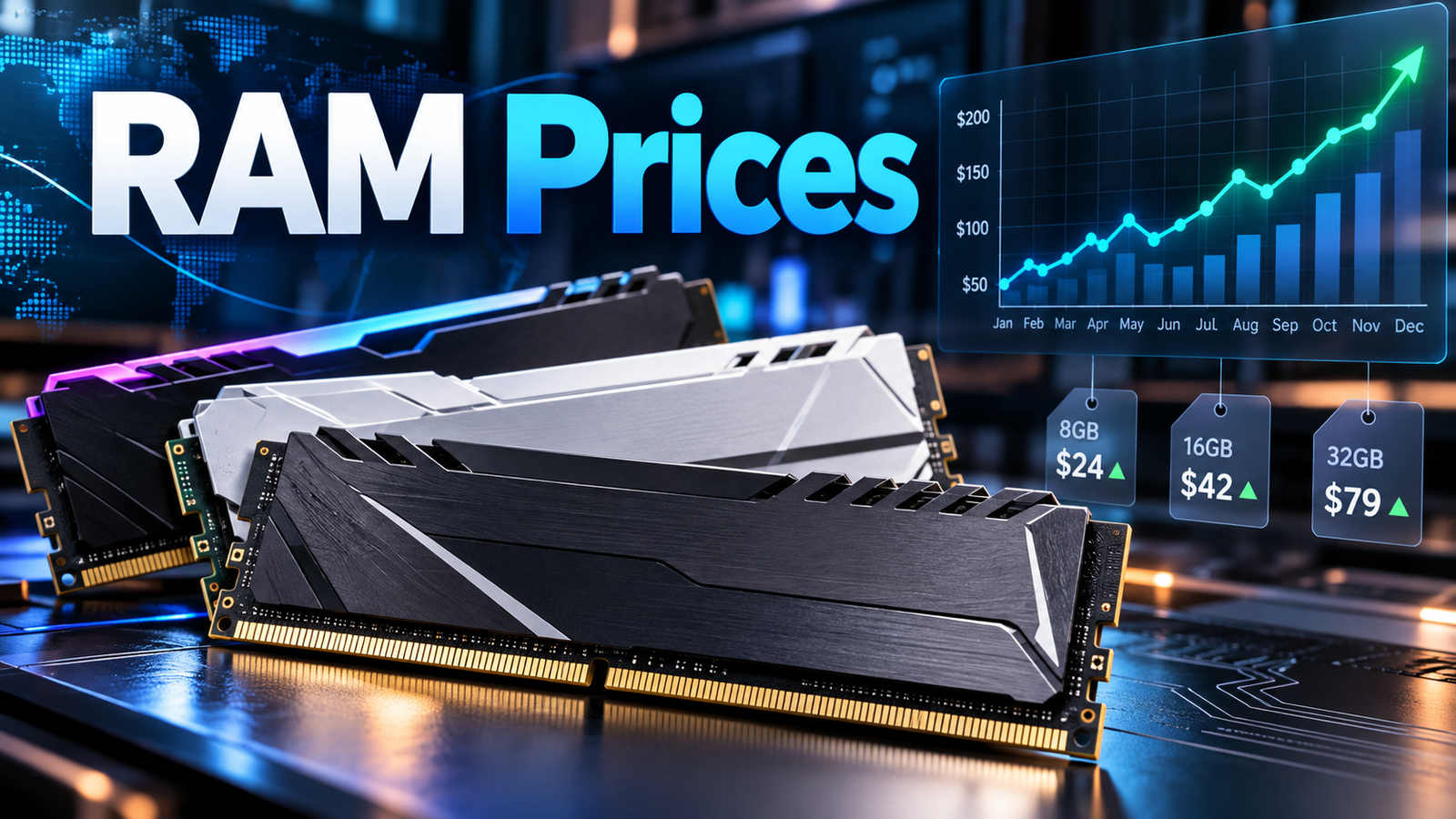
RAM prices have changed dramatically in 2026, making memory one of the most expensive components in many PC upgrades and new builds. The biggest pressure is coming from tight DRAM supply, strong AI and data-center demand, and manufacturers shifting capacity toward higher-value server memory and HBM.
For buyers, the important question is not simply “How much does RAM cost?” It is whether a particular kit offers reasonable value for its capacity, speed, latency, and platform.
As of late September 2026, TrendForce expects conventional DRAM contract prices to rise another 10–15% quarter over quarter in Q4 2026. Retail prices vary by country, seller, capacity, and stock, so a RAM price chart or tracker is more useful than relying on one fixed price.
RAM Prices at a Glance
Current retail pricing is unusually volatile. For example, Tom’s Hardware’s U.S. RAM price tracker reported a 32GB DDR5 kit starting around $350 in late September, while some 32GB DDR5 deals had recently appeared below $400.
| RAM Type | Capacity | Typical Use | Current Market Situation |
| DDR4 | 16GB | Office, older PCs | Elevated compared with historical lows |
| DDR4 | 32GB | Gaming, productivity | More expensive than previous years |
| DDR5 | 16GB | Entry-level/new systems | High and volatile |
| DDR5 | 32GB | Gaming and general use | Particularly expensive |
| DDR5 | 64GB+ | Workstations, heavy workloads | Significant premium |
These are broad market observations rather than guaranteed retail prices. RAM prices can change quickly when inventory moves, a sale appears, or a particular kit goes out of stock.
How Much Does RAM Cost by Capacity?
Capacity is one of the easiest ways to compare memory prices, but buying more RAM is not always the best upgrade.
8GB RAM
8GB can still work for basic browsing, office applications, and lightweight computing. However, modern multitasking can quickly consume that capacity, making 16GB a more practical starting point for many users.
16GB RAM
16GB remains suitable for general productivity and many gaming systems. It is also a common capacity for laptops and budget-oriented PCs.
32GB RAM
32GB has become an important target for gaming, content creation, and heavier multitasking. However, the current RAM market has made 32GB DDR5 considerably more expensive than it was before the shortage.
Tom’s Hardware reported that 32GB DDR5 kits that commonly sold for roughly 100–200 in October 2025 had reached around $350 or more by September 2026.
64GB and Above
64GB and larger configurations make more sense for demanding workloads such as professional video editing, 3D applications, virtual machines, software development, and other memory-intensive tasks.
For ordinary gaming and office use, paying a large premium for 64GB may not provide a meaningful benefit.
DDR4 vs DDR5 RAM Prices
DDR4 and DDR5 should not be treated as interchangeable price categories.
DDR5 is the newer memory standard and is used by modern platforms, while DDR4 remains relevant for older systems. The important surprise in the current market is that DDR4 is not automatically cheap simply because it is older.
| Factor | DDR4 | DDR5 |
| Generation | Older | Newer |
| Typical platform | Existing/older PCs | Newer PCs |
| Bandwidth | Lower | Higher |
| Upgrade choice | Existing DDR4 system | New DDR5 system |
| Current pricing | Elevated | Particularly volatile |
| Best reason to buy | Upgrade compatible hardware | New system or DDR5 upgrade |
Reduced production of mature memory products can tighten availability. At the same time, demand for newer memory and server products is drawing manufacturing capacity toward higher-value applications. TrendForce says major suppliers are reallocating capacity toward server applications, contributing to tight PC DRAM supply.
Is DDR4 Actually Cheaper Than DDR5?
Often it can be, but the difference should not be assumed.
For example, a person upgrading an existing DDR4 PC may find a DDR4 kit cheaper than replacing the motherboard, processor, and memory with a new DDR5 platform. For someone building a new computer, however, buying into an older DDR4 platform solely to save money may not make sense.
The right comparison is therefore total platform cost, not just the RAM price.
Why Are RAM Prices So High in 2026?
The current increase is the result of several market forces rather than one single shortage.
AI Data Centers Are Increasing Memory Demand
Modern AI systems require enormous amounts of high-performance memory. Cloud providers and data-center operators are expanding infrastructure for AI training and inference, increasing demand for server DRAM and HBM.
TrendForce says AI server demand is keeping DRAM supply tight and that suppliers are prioritizing advanced-process capacity for high-performance server products.
HBM Is Putting Pressure on Memory Capacity
High Bandwidth Memory, or HBM, is critical to modern AI accelerators. It uses stacked memory technology to provide extremely high bandwidth to processors.
The important point is that HBM and conventional DRAM are connected through manufacturing capacity. Samsung said HBM could account for nearly 30% of global DRAM wafer capacity next year, compared with about 20% currently.
That does not mean AI is literally consuming every consumer RAM module. Instead, growing HBM production can reduce the manufacturing capacity available for other memory products.
Manufacturers Are Prioritizing Server Memory
Server memory can generate attractive returns for manufacturers, especially when cloud providers place large orders.
TrendForce reports that suppliers are shifting capacity toward server DRAM and enterprise applications, creating tighter supply for PC and other consumer segments.
DDR4 and Mature Products Face Supply Pressure
Older memory products can become unexpectedly expensive when manufacturers reduce output.
That creates an unusual situation: an older RAM standard can become expensive because there is less incentive for manufacturers to keep producing large quantities of it.
RAM Price Chart: 2025 vs 2026
A useful RAM prices chart needs to distinguish historical retail prices from semiconductor contract and spot prices.
For consumer buyers, one of the clearest examples is 32GB DDR5. Tom’s Hardware reported that conventional 32GB DDR5 kits were commonly around 100–200 in October 2025, while the same capacity had reached roughly $350 or more in September 2026.
TrendForce’s chip-level data shows another side of the market. On October 2, its reported session-average spot prices were about $58 for a 16Gb DDR5 4800/5600 chip and about $83.59 for a 16Gb DDR4 3200 chip. These are DRAM chip spot prices, not the retail price of a finished RAM kit, so they should not be compared directly with store listings.
This distinction matters when reading a RAM price chart: different charts can measure different points in the supply chain.
Are RAM Prices Still Rising?
The answer is nuanced.
Some spot-market activity has been relatively quiet, and individual products can temporarily fall in price. But that does not necessarily mean the overall shortage is over.
TrendForce’s September 30 forecast projected conventional DRAM contract prices to increase 10–15% quarter over quarter in Q4 2026. It also reported that suppliers continue prioritizing server products, leaving the broader market undersupplied.
In other words, slower price growth is not the same as a return to cheap RAM.
Will RAM Prices Go Down?
There is no reliable date when RAM prices will return to previous lows.
Prices could eventually ease if manufacturers add sufficient capacity, inventories recover, AI infrastructure spending slows, or consumer demand weakens. On the other hand, continued AI server expansion and strong HBM demand could keep pressure on memory supply.
TrendForce’s current outlook indicates that memory supply constraints are expected to remain significant because AI demand continues to compete for advanced manufacturing capacity.
For that reason, predictions such as “RAM will definitely become cheap by a specific month” should be treated cautiously.
Should You Buy RAM Now or Wait?
The right decision depends on your situation.
Buy RAM Now If You Actually Need It
Consider buying now if:
- Your computer is regularly running out of memory.
- You need an upgrade for work or gaming.
- Your existing RAM is difficult to find.
- You find a good price on a compatible kit.
- A new PC build is ready and delaying it has little benefit.
Consider Waiting If Your Current RAM Is Enough
Waiting can make sense if:
- Your current system performs normally.
- You are upgrading only because prices may rise further.
- You do not have an immediate workload requiring additional memory.
- You are planning a broader PC upgrade.
Existing PC vs New PC
For an existing DDR4 computer, a reasonably priced DDR4 upgrade may be more sensible than replacing the entire platform.
For a new PC, compare the total motherboard, CPU, and RAM cost rather than choosing a platform solely because its memory appears cheaper.
What Makes One RAM Kit More Expensive?
RAM prices can differ substantially even when two kits have the same capacity.
Capacity
A 32GB kit normally costs more than a 16GB kit, although the price per gigabyte can vary.
Speed
Faster memory can carry a premium, but the benefit depends on the CPU and workload.
CAS Latency
Two DDR5 kits can have the same advertised speed but different timings. A lower latency specification may increase the price.
XMP and EXPO
Intel XMP and AMD EXPO profiles make it easier to run compatible memory at its advertised performance settings. Compatibility with your motherboard and processor still matters.
RGB and Premium Features
RGB lighting, heat spreaders, premium designs, and enthusiast branding can increase the cost without producing a proportional performance improvement.
For example, if two 32GB kits have similar speed and latency but one costs substantially more because of RGB styling, the cheaper kit may provide better performance per dollar.
How Much RAM Do You Actually Need?
| User Type | Practical Starting Point |
| Basic browsing and office work | 8–16GB |
| General productivity | 16GB |
| Modern gaming | 16–32GB |
| Content creation | 32–64GB |
| Professional workloads | 64GB+ |
These are practical guidelines rather than hard requirements. The best amount depends on your applications, operating system, game library, and multitasking habits.
How to Check Your RAM Usage
On Windows:
- Press Ctrl + Shift + Esc to open Task Manager.
- Select Performance.
- Choose Memory.
- Check how much memory your system is using.
- Monitor it while running the applications or games you normally use.
If your system rarely approaches its available capacity, adding more RAM may not improve performance.
How to Get the Best RAM Price
Don’t compare RAM based only on its advertised gigabytes.
Check the:
- DDR generation
- Capacity
- Speed
- CAS latency
- Kit configuration
- Motherboard compatibility
- CPU compatibility
- Warranty
- Current stock
A RAM price tracker can be particularly useful in the current market because prices can change quickly. Tom’s Hardware, for example, maintains a U.S. tracker covering DDR4 and DDR5 kits across multiple capacities and speeds.
Also compare the price per GB, but don’t let that number override compatibility or performance requirements.
RAM Buying Mistakes to Avoid
Avoid buying a large-capacity kit simply because it is on sale.
Do not assume DDR4 and DDR5 are interchangeable, and check whether your motherboard supports the memory you intend to purchase.
Finally, don’t panic-buy based on a single RAM price chart. Look at multiple listings and compare equivalent specifications. A high-capacity kit with poor compatibility is not a bargain.
Frequently Asked Questions About RAM Prices
How much does RAM cost in 2026?
RAM prices vary significantly by capacity, DDR generation, speed, region, and availability. In the U.S. market, 32GB DDR5 kits have recently been selling around the 350–400+ range, while DDR4 can be less expensive but is also experiencing substantial price pressure.
Why are RAM prices so high right now?
The main factors include strong AI and data-center demand, HBM production, server DRAM demand, and manufacturers reallocating capacity toward higher-value memory products.
Is DDR5 RAM more expensive than DDR4?
Generally, DDR5 can command a higher price, particularly for high-performance and high-capacity kits. However, DDR4 prices have also risen sharply, so the difference is not always as large as buyers might expect.
Is 32GB RAM enough for gaming?
For many modern gaming PCs, 32GB is a comfortable target. However, actual requirements vary by game, background applications, resolution, and other workload factors.
Should I buy RAM now or wait?
Buy now if you need additional memory and find a reasonable compatible kit. If your current RAM is sufficient, waiting can be sensible because current prices remain volatile and forecasts are uncertain.
Why is DDR4 RAM still expensive?
Reduced production of mature memory products can tighten DDR4 supply. Older technology does not automatically become cheaper when manufacturers reduce output.
Where can I track RAM prices?
Use regularly updated RAM price trackers and compare equivalent kits. Look for the same capacity, speed, latency, and configuration rather than comparing headline prices alone. Tom’s Hardware maintains a current U.S. DDR4/DDR5 tracker, while TrendForce provides industry-level DRAM spot and contract pricing data.
Conclusion
RAM prices in 2026 are being shaped by an unusual combination of AI-driven demand, HBM production, server memory requirements, and constrained DRAM manufacturing capacity. DDR4 has not escaped the pressure, while DDR5 remains particularly expensive in many retail markets.
For buyers, the smartest approach is to compare the complete specification and current market price rather than chasing a specific RAM generation. If you need an upgrade now, buy a compatible kit at a reasonable price. If your current system has enough memory, there is little reason to upgrade purely because of market headlines.
Because RAM pricing is changing quickly, a dated price chart or tracker is more useful than any permanent “average RAM price.”
You May Also Read: BacktoFrontShow Pricing



One thought on “RAM Prices in 2026: Current Costs, Trends & Buying Guide”